Interpretation of the Bonding Conductor Continuity Test
8.4.1 - Protective conductor continuity
All protective and bonding conductors must be tested to ensure that they are electrically safe and correctly connected. {8.7.1} gives test instrument requirements. Provided that the supply is not yet connected, it is permissible to disconnect the protective and equipotential conductors from the main earthing terminal to carry out testing. Where the mains supply is connected, as will be the case for periodic testing, the protective and equipotential conductors must not be disconnected because if a fault occurs these conductors may rise to a high potential above earth. In this case, an earth-fault loop tester can be used to verify the integrity of the protective system.
Where earth-fault loop impedance measurement of the installation is carried out, this will remove the need for protective conductor tests because that conductor forms part of the loop. However, the loop test cannot be carried out until the supply is connected, so testing of the protective system is necessary before supply connection, because connection of the supply to an installation with a faulty protective system could lead to danger.
There are three methods for measurement of the resistance of the protective conductor.
1. - Using the neutral conductor as a return lead
| Rp = R x | An |
| An + Ap |
| where |
| Rp - is the resistance of the protective conductor |
| R - is the resistance reading taken |
| An - is the cross-sectional area of the neutral conductor |
| Ap - is the cross-sectional area of the protective conductor. |
Note that the instrument reading taken in this case is the value of the resistance R1 + R2 calculated from {Table 5.5} (see {8.4. 4 }) . This method is only valid if both conductors have the same length and both are copper; in most cases where steel conduit or trunking is not used as the protective conductor, the test will give correct results.
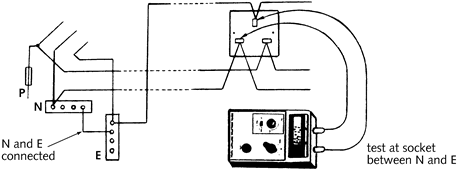
Fig 8.2 - Protective conductor continuity test using the
neutral conductor as the return lead
2. - Using a long return lead
Second, take the meter with its long lead still connected to the point from which continuity measurement is required, and connect the second meter terminal to the protective conductor at that point.
| Rp = R - RL |
| where |
| Rp - is the resistance of the protective conductor |
| R - is the resistance reading taken |
| RL - is the resistance of the long lead |
3. - Where ferrous material forms all or part of the protective conductor
There are some cases where the protective conductor is made up wholly or in part by conduit, trunking, steel wire armour, and the like. The resistance of such materials will always be likely to rise with age due to loose joints and the effects of corrosion. Three tests may be carried out, those listed being of increasing severity as far as the current-carrying capacity of the protective conductor is concerned. They are:
1 - A standard ohmmeter test as indicated in 1 or 2 above. This is a low current test which may not show up poor contact effects in the conductor. Following this test, the conductor should be inspected along its length to note if there are any obvious points where problems could occur.
2 - If it is felt by the inspector that there may be reasons to question the soundness of the protective conductor, a phase-earth loop impedance test should be carried out with the conductor in question forming part of the loop. This type of test is explained more fully in {8.4.4}
3 - If it is still felt that the protective conductor resistance is suspect, the high current test using 1.5 times the circuit design current (with a maximum of 25 A) may be used (see {Fig 8.3}. The protective circuit resistance together with that of the wander lead can be calculated from:
| voltmeter reading (V) |
| |
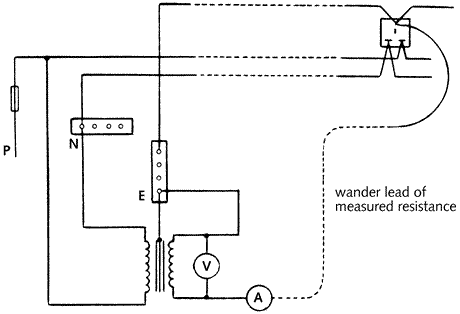
Fig 8.3 - High-Current ac test of a protective conductor
Subtracting wander lead resistance from the calculated value will give the resistance of the protective system.
The resistance between any extraneous conductive part and the main earthing terminal should he 0.05 Ohms or less; all supplementary bonds are also required to have the same resistance.
Source: https://www.tlc-direct.co.uk/Book/8.4.1.htm
0 Response to "Interpretation of the Bonding Conductor Continuity Test"
Post a Comment